
.
Botulin toxin (Botox®) injections are used for the treatment of anal fissure. It works by temporarily paralysing a portion of the internal sphincter muscle.
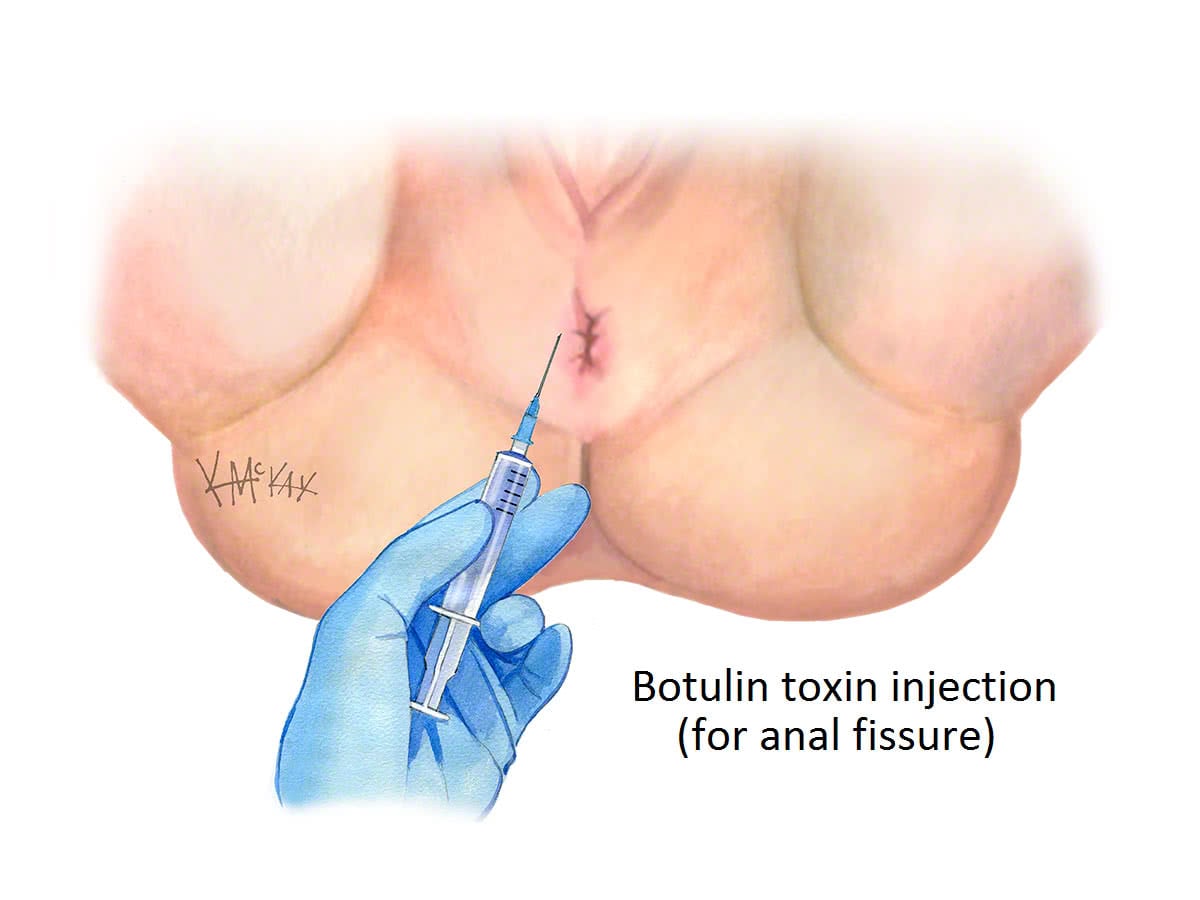
Mechanism of Action
By relaxing the lowermost fibres of the internal anal sphincter, it allows the anal fissure to no longer be stretched and torn with each bowel motion.
Effectiveness
Neurotoxins such as Botulin toxin A have the advantage of being effective in 60-80% of cases as well as being reversible and repeatable.
Cost
Unfortunately, Botox is not covered by Medicare or PBS in many public hospitals in Australia, although a number of public hospitals in Sydney have successfully campaigned to make it available free of charge for the treatment of anal fissure. Neurotoxins such as botulin toxin A can be injected in the consulting rooms but the costs of almost $500 per injection remains prohibitive. Neurotoxin injections such as Botulin toxin A for anal fissure administered in a private hospital is usually not covered by your health insurance fund and an out of pocket cost of $500 is usual.
Side Effects and Complications
There have been reports of temporary incontinence in 20% of patients after botulin toxin A injection [1]. The benefit of Botulin toxin A, is that the paralysing effect only lasts for 2-3 months, with complete recovery of muscle function after this. This is enough time in most cases to allow the anal fissure to heal. Long-term permanent incontinence has not been reported after 1-2 does. This is in contrast to surgery (i.e. lateral internal sphincterotomy) where the rates of permanent mild incontinence are as high as 20%, and complete incontinence up to 5%.2 Combination Botulin and topical gels such as those already mentioned are more likely to work than either on its own.
References
1. Nasr M. Ezzat H. Elsebae M. Botulin Toxin Injection versus lateral internal sphincterotomy in the treatment of chronic anal fissure: a randomized controlled trial. World J Surg34:2730-2734 2010 Aug.