.
Abdominal incisional hernias are an uncommon but significant complication following open abdominal surgery, such as laparotomy.
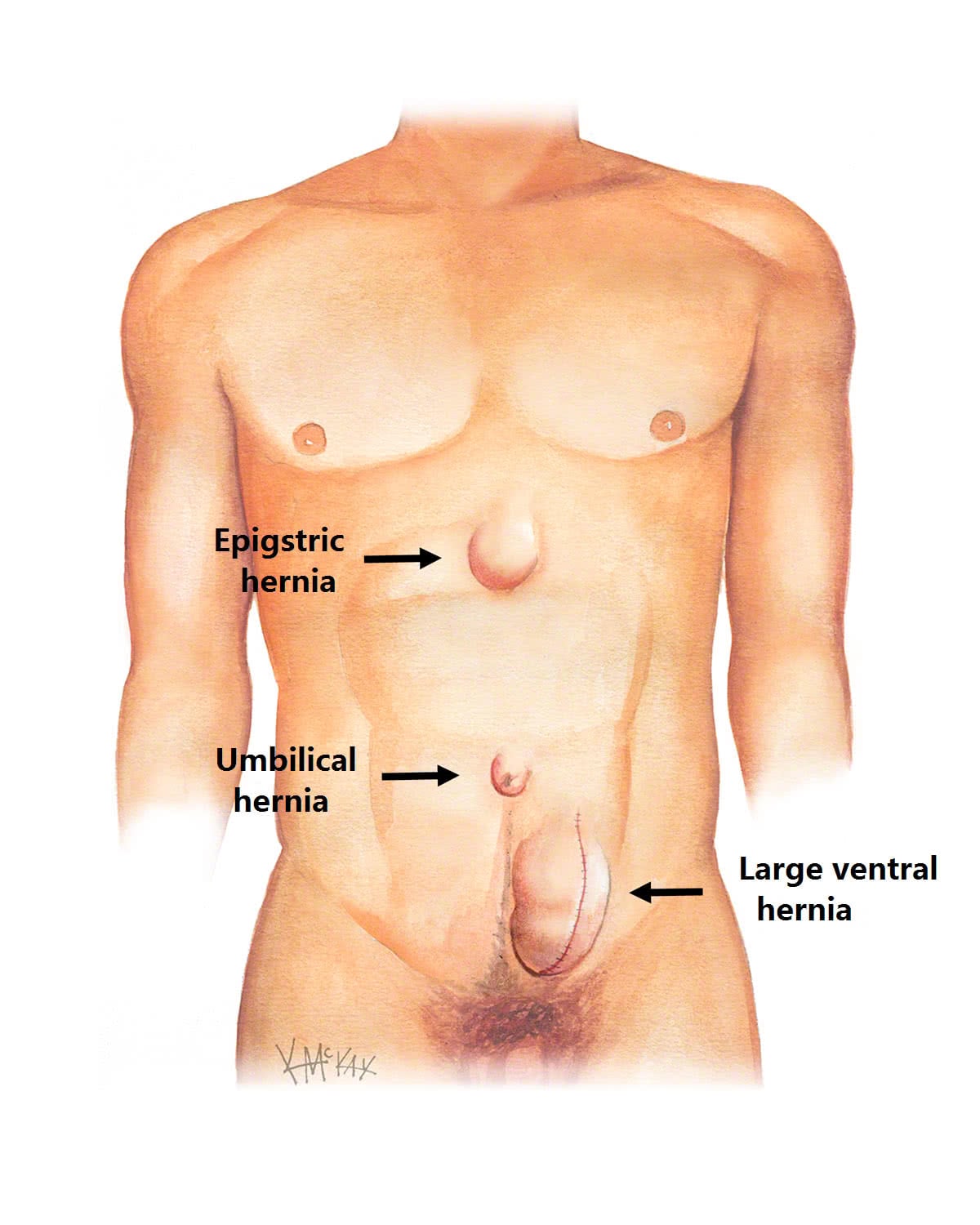
Location
They may occur at the umbilicus, above the umbilicus (epigastric), or extend along the length of the surgical incision, resulting in a massive ventral hernia (Figure 1).
How do they form?
During surgery an incision is made in the muscles that make up the abdomen. For some reason, that muscle doesn’t heal, so a gap opens up as the muscles tighten and release during activities. Instead of a flat, strong piece of muscle, you have a piece of muscle that has a small gap in it. After a while, the tissues underneath realize there is an escape route through the muscle, and they start to poke through the opening, where they can be felt under the skin.
Who is at risk for an incisional hernia?
Incisional hernias are more common in the obese, elderly, smokers, those with poor nutrition and those on immunosuppression.
Participation in activities that increase abdominal pressure like heavy lifting, straining or coughing, increase the risk of developing an incisional hernia.
The incision is weakest, and most prone to a hernia, during the first 6-12 weeks after surgery while it is still healing. While incisional hernias can develop or enlarge months or years after surgery, they are most likely to occur in the first 6-12 weeks following surgery.
Diagnosing an incisional hernia
Incisional hernias can be diagnosed clinically. These hernias may seem to appear and disappear, which is referred to as a “reducible” hernia.
The hernia may not be noticeable unless the patient is involved in an activity that increases abdominal pressure, such as coughing, sneezing, pushing to have a bowel movement, or lifting a heavy object.
CT scan or ultrasound is sometimes necessary to determine the extent of the hernia as well as its contents. Sometimes these imaging modalities also determine synchronous hernias nearby.
Incisional hernia treatment
An incisional hernia may not be symptomatic and small enough that surgical repair is an option. If the hernia is large, causes pain or is steadily growing, surgery may be recommended. Another option is a truss, a garment that is similar to a weight belt or girdle, that applies constant pressure to the hernia. These may be a useful temporising measure until hernia surgery is performed, or used for those too frail to undergo surgery.
When is incisional hernia surgery necessary?
An Incisional hernia may require surgery if it is painful, enlarges over time, is cosmetically unappealing, or irreducible. In many cases surgery can be performed laparoscopically with small key-hole incisions.
