
What is an Abdominoplasty?
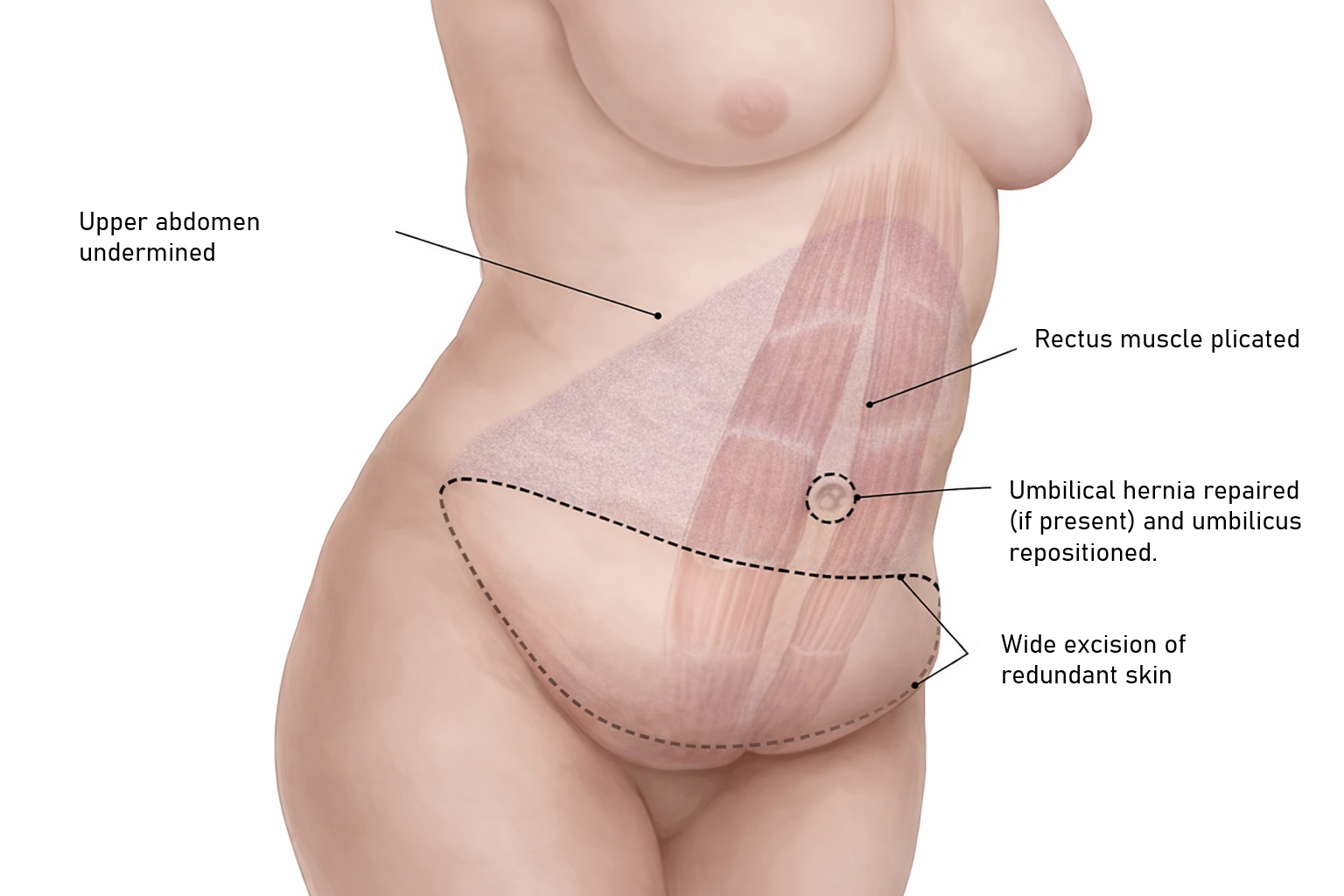
Abdominoplasty, commonly known as a “tummy tuck,” is a surgical procedure that removes excess skin and fat from the lower abdomen and tightens the abdominal wall muscles. In many patients, it also involves repair of separation of the rectus muscles (rectus sheath diastasis) and repositioning of the umbilicus (belly button).
While often considered a cosmetic procedure, abdominoplasty can also be medically indicated in selected patients.
When is Abdominoplasty Medically Indicated?
Abdominoplasty may be considered medically necessary when one or more of the following conditions are present:
Chronic Back Pain
Significant abdominal wall weakness or muscle separation can reduce core stability.
In some patients, tightening the abdominal wall improves posture and core strength, helping to relieve chronic lower back pain.
Rectus Sheath Diastasis (> 3 cm)
Rectus diastasis refers to separation of the rectus abdominis muscles.
When the separation is greater than 3 cm, it may result in:
- Core weakness
- Abdominal bulging
- Functional impairment
- Back pain
Surgical plication (tightening) of the rectus sheath restores abdominal wall integrity.
Large Fatty Apron (Pannus) with Recurrent Infections
A large overhanging abdominal apron (pannus) can cause:
- Recurrent intertrigo
- Chronic candidal (fungal) infections
- Skin ulceration
- Hygiene difficulties
- Persistent rashes despite medical treatment
In these cases, removal of the pannus can significantly improve quality of life and reduce recurrent infections.
Combined with Incisional Hernia Repair
Abdominoplasty may be performed at the same time as incisional hernia repair, particularly when:
- There is redundant abdominal skin
- The abdominal wall is weak
- There is associated rectus diastasis
Combining procedures can improve both functional and structural outcomes.
What Does the Operation Involve?
Abdominoplasty is a major surgical procedure and typically involves:
- A long lower abdominal incision (hip to hip)
- Removal of excess skin and fat
- Tightening (plication) of the rectus muscles
- Repositioning of the umbilicus
- Placement of subcutaneous drains
The operation usually takes more than 2 hours, depending on complexity.
Hospital Stay and Recovery
- Patients are typically admitted to hospital.
- Subcutaneous drains are usually left in place for approximately 5 days.
- Early mobilisation is encouraged to reduce complications.
- Most patients require several weeks off work.
- Heavy lifting is restricted for approximately 6 weeks.
Full recovery and final contour improvement may take several months.
Risks and Complications
Because abdominoplasty is a long operation with a multi-day hospital stay, it carries risks associated with major surgery.
General Risks of Major Surgery
- Deep Vein Thrombosis (DVT)
- Pulmonary Embolism (PE)
- Atelectasis (partial lung collapse)
- Pneumonia
- Bleeding
- Infection
- Anaesthetic complications
Preventative measures include compression devices, early mobilisation, and sometimes anticoagulant medication.
Procedure-Specific Risks
Skin Complications
- Delayed wound healing
- Wound breakdown
- Seroma (fluid collection)
- Haematoma
Skin Necrosis
Skin necrosis (tissue death) is a recognised risk, particularly involving:
- The lower abdominal flap
- The relocated umbilicus, which has a more vulnerable blood supply
Smokers and patients with diabetes are at higher risk.
Umbilical Complications
- Loss of the umbilicus (rare but possible)
- Abnormal scarring
- Malposition
Recurrence of Muscle Separation
Although uncommon, recurrence of rectus diastasis may occur.
Scarring
A long scar across the lower abdomen is permanent, although it usually fades over time.
Is Abdominoplasty Right for You?
Abdominoplasty is most appropriate for patients who:
- Have stable weight
- Do not smoke (or are willing to stop)
- Have realistic expectations
- Understand the risks of major surgery
This is not a substitute for weight loss or treatment of obesity.
Important Considerations
Because this procedure:
- Takes more than 2 hours,
- Involves significant tissue dissection,
- Requires a hospital stay with drains for approximately 5 days,
It should be approached as major reconstructive surgery, not a minor cosmetic procedure.
A thorough consultation, physical examination, and discussion of risks and expected outcomes are essential before proceeding.