
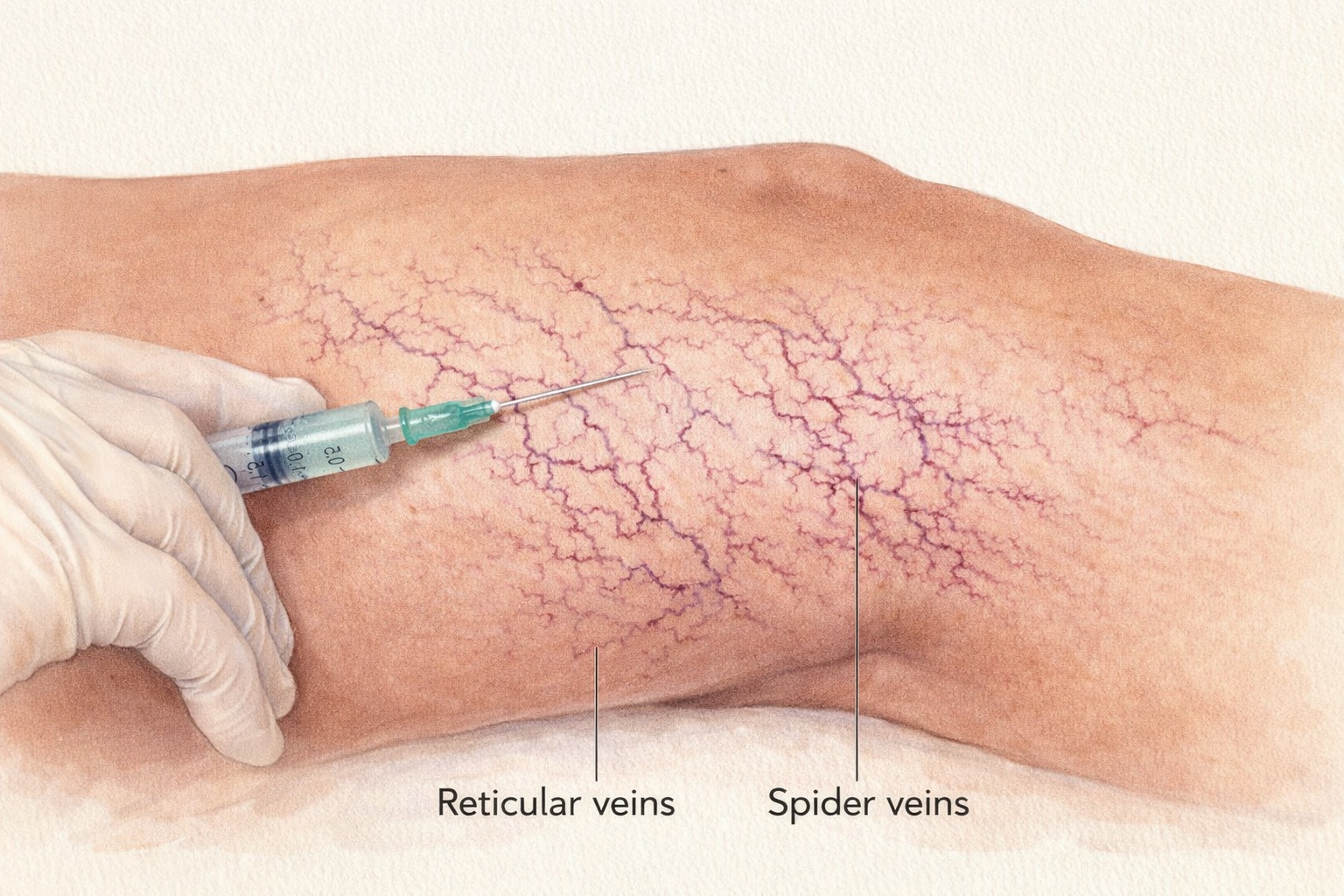
What is sclerotherapy?
Sclerotherapy is a procedure in which a medication known as a sclerosant (for example, Aethoxysklerol) is injected directly into a vein using a very fine needle. The solution irritates the inner lining of the vein, causing it to collapse and seal closed. Over time, the body naturally absorbs the treated vein.
Microsclerotherapy
Spider veins are managed with microsclerotherapy. In this technique, the tiny veins are injected under direct vision, and ultrasound guidance is usually not required.
The sclerosant – Aethoxysklerol
Treatment with Aethoxysklerol is generally highly effective. Approximately 70% of patients achieve excellent improvement after a single treatment cycle, although multiple sessions are often needed to obtain the best outcome. In some cases, particularly where veins are significantly incompetent, they may respond less well and not clear completely with sclerotherapy alone.
It is important to note that sclerotherapy does not address underlying genetic or hormonal factors that may contribute to vein formation. As a result, new veins can develop or previously treated veins may recur. If this occurs, further treatment can usually be performed.
Common side effects include:
Mild discomfort
Local inflammation
Bruising
Swelling
Firm or tender lumps along the treated vein
Temporary skin pigmentation
Fine red vessel “matting”
When will results be visible?
The treated vein gradually fades as the body breaks it down, typically over 4–6 weeks. Final results may take 6–12 months to fully develop, and several treatment sessions may be required to achieve the desired outcome.